Practise the decision before the call comes in
At a real incident nobody gets ten quiet minutes to look something up. The first decisions are made quickly, under pressure, from whatever is already in your head. Training is how it gets there.
This post looks at what the research says about one simple way of putting it there: answering questions, regularly, and being told why.
Answering beats re-reading
Most of us revise by re-reading: the notes, the guidance, the slides from the last course. It feels productive. The research says it is one of the weaker ways to learn.
In a 2006 study, students read a short passage, then either read it again or took a recall test on it. Five minutes later, the re-readers remembered more. Two days and a week later, the tested group remembered substantially more. In a second experiment, the students who did nothing but re-read were the most confident they would remember the passage a week later, and remembered the least. The authors put their conclusion in one line:
"Testing is a powerful means of improving learning, not just assessing it." (Roediger and Karpicke, 2006)
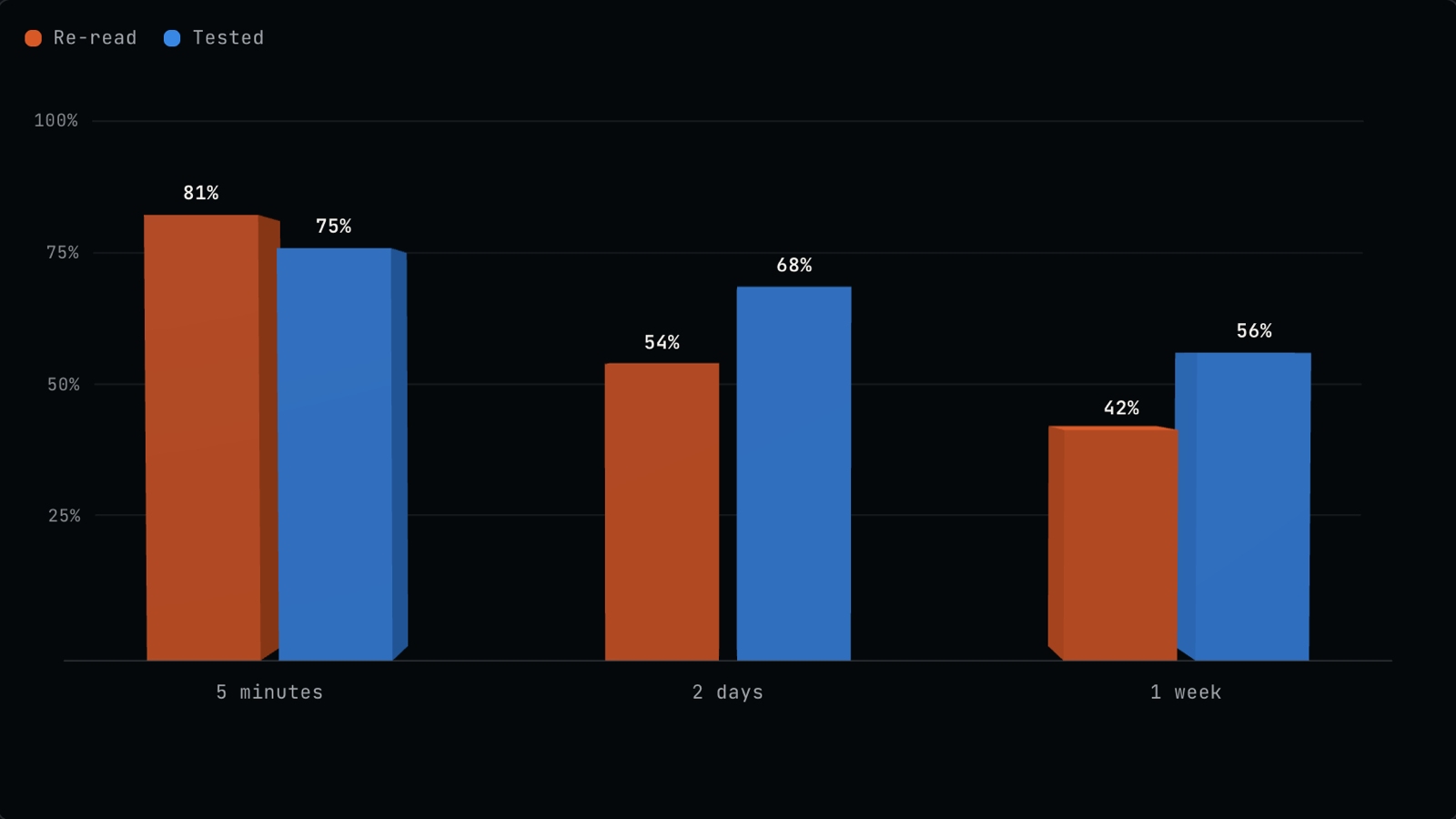
| Recalled after | Re-read | Tested |
|---|---|---|
| 5 minutes | 81% | 75% |
| 2 days | 54% | 68% |
| 1 week | 42% | 56% |
That is the case for a quiz. The question is not only there to find out what you know. Pulling the answer out of memory is what makes it stay.
Little and often
A 2013 review compared ten common learning techniques against the evidence for each. Rereading and highlighting, the two most of us reach for, were rated low. Only two techniques earned the top rating:
"Practice testing and distributed practice received high utility assessments because they benefit learners of different ages and abilities and have been shown to boost students' performance across many criterion tasks and even in educational contexts." (Dunlosky and colleagues, 2013)
Distributed practice means spreading the work out over time. On a watch, that points to one quiz a shift rather than a morning of them the week before an assessment.
Why every answer comes with a reason
Multiple choice has a known weakness: a wrong option you picked can stick. A 2008 study found that feedback helps. It raised the number of correct answers on a later test and reduced the number of wrong options people carried forward. The advice was direct:
"Educators should provide feedback when using multiple-choice tests." (Butler and Roediger, 2008)
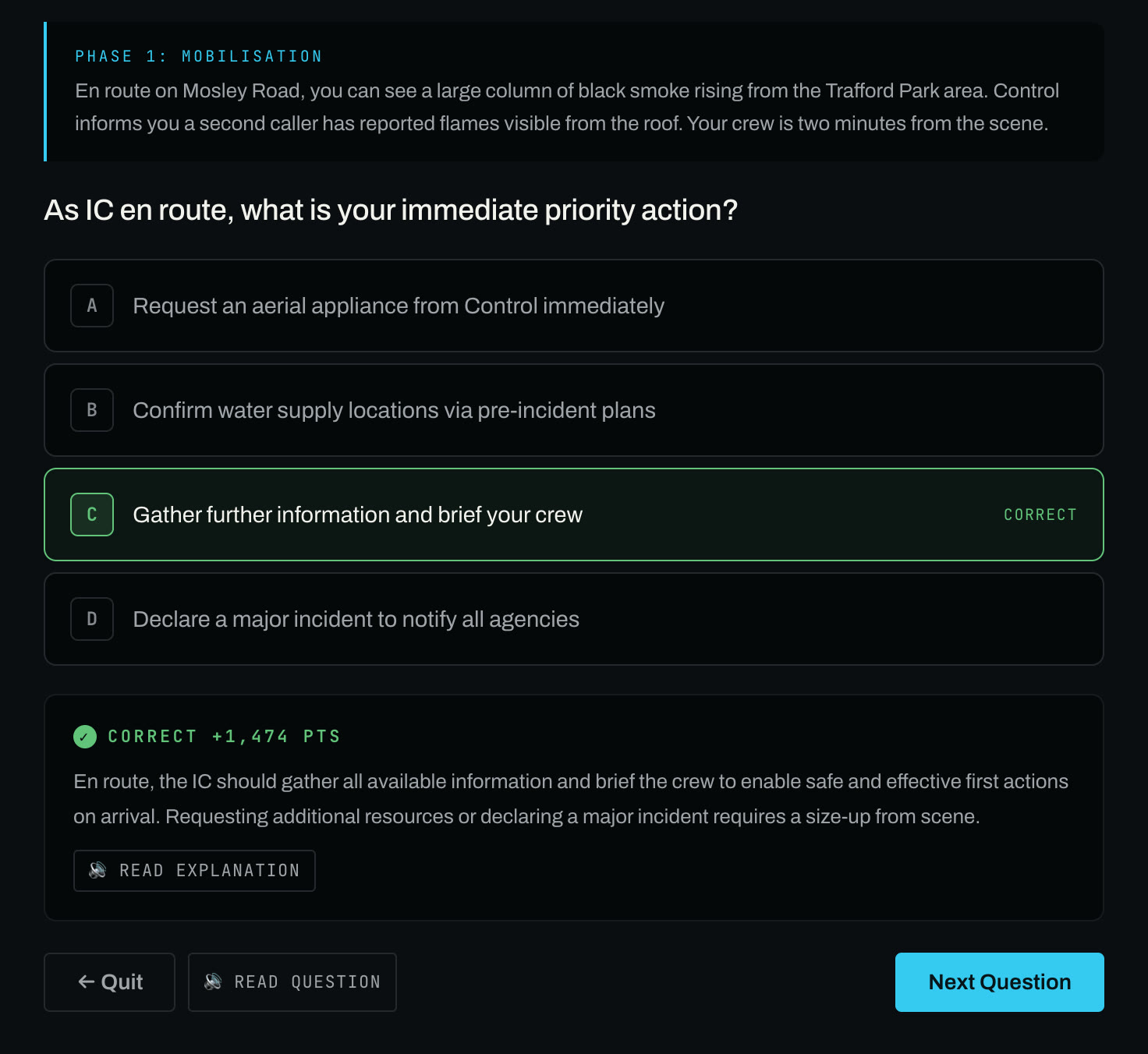
That is why every CommandGrid Quiz question is followed by an explanation of the right answer, and why HazardGrid gives feedback at each step rather than a single score at the end.
What the fireground evidence adds
Those studies were done with learners and written passages. The UK fire and rescue service has evidence of its own, and it is closer to home.
In a study published in 2015, incident commanders attending 33 real incidents across six UK fire and rescue services wore helmet-mounted cameras. Afterwards the footage was used to prompt them to talk through their decisions. The finding:
"The analysis revealed that assessment of the operational situation was most often followed by plan execution rather than plan formulation, and there was little evidence of prospection about the potential consequences of actions." (Cohen-Hatton, Butler and Honey, 2015)
In plain terms, commanders tended to look and then act, without stopping to form a plan or think through what might happen next. The pattern held across different kinds of incident, and it changed with operational experience. Under pressure, people act on what they recognise, which is exactly why what you have practised matters.
A second study by the same team asked whether training could change that pattern. Commanders received either standard training or training with added "decision controls": prompts to weigh goals, anticipated consequences, and risk against benefit once a course of action had been identified. They then ran scenarios in a virtual environment, on the fireground and at a live burn.
"In all experiments, groups given standard training showed the reported tendency to move directly from information gathering to action, whereas those given goal-oriented training were more likely to develop explicit plans and show anticipatory situational awareness." (Cohen-Hatton and Honey, 2015)
How people decide on the day is shaped by how they practised. Our quizzes are not the training tested in that study, but they keep asking the questions it was about: who is at risk, what is at stake, and what happens next if you commit.
How the quizzes put this to work
- CommandGrid Quiz. Twelve questions on one incident, in the order it unfolds: first arrival, immediate hazards, establishing command, escalation, multi-agency working, the legislation behind it, and the stand-down and debrief. Each phase opens with a situation update, and every answer is explained. About ten minutes, solo or as a watch.
- HazardGrid. An incident scene to work through. Take the sixty-second spot-the-hazards drill, or the full dynamic risk assessment: who is at risk, what is at stake, control measures and command decisions, with feedback at each step.
- WatchBrief. A narrated incident for the watch room. It develops in stages on the big screen and the watch answers command questions together, so you practise talking a decision through as well as making it.
All three are free to try in the browser, with no account and nothing to install, on the station tablet or your own phone. They are written from current UK operational guidance, and they work best alongside your own service's procedures, drills and exercises.
Try one this shift
Ten minutes is enough. Pick a quiz, answer it, read the explanations for the ones you got wrong, and come back to another next shift. That is practice testing, spaced out, with feedback: the combination the research rates most highly.
Sources
- Roediger, H. L., and Karpicke, J. D. (2006). Test-enhanced learning: Taking memory tests improves long-term retention. Psychological Science, 17(3), 249–255. doi.org/10.1111/j.1467-9280.2006.01693.x
- Dunlosky, J., Rawson, K. A., Marsh, E. J., Nathan, M. J., and Willingham, D. T. (2013). Improving students' learning with effective learning techniques. Psychological Science in the Public Interest, 14(1), 4–58. doi.org/10.1177/1529100612453266
- Butler, A. C., and Roediger, H. L. (2008). Feedback enhances the positive effects and reduces the negative effects of multiple-choice testing. Memory & Cognition, 36(3), 604–616. doi.org/10.3758/MC.36.3.604
- Cohen-Hatton, S. R., Butler, P. C., and Honey, R. C. (2015). An investigation of operational decision making in situ: Incident command in the U.K. Fire and Rescue Service. Human Factors, 57(5), 793–804. doi.org/10.1177/0018720815578266
- Cohen-Hatton, S. R., and Honey, R. C. (2015). Goal-oriented training affects decision-making processes in virtual and simulated fire and rescue environments. Journal of Experimental Psychology: Applied, 21(4), 395–406. doi.org/10.1037/xap0000061