What the revised incident command guidance says about losing the radio
A radio that works fine in the station yard can go quiet three floors down a car park stairwell. Crews have always known this. Since September, the national incident command guidance spells out what should be done about it.
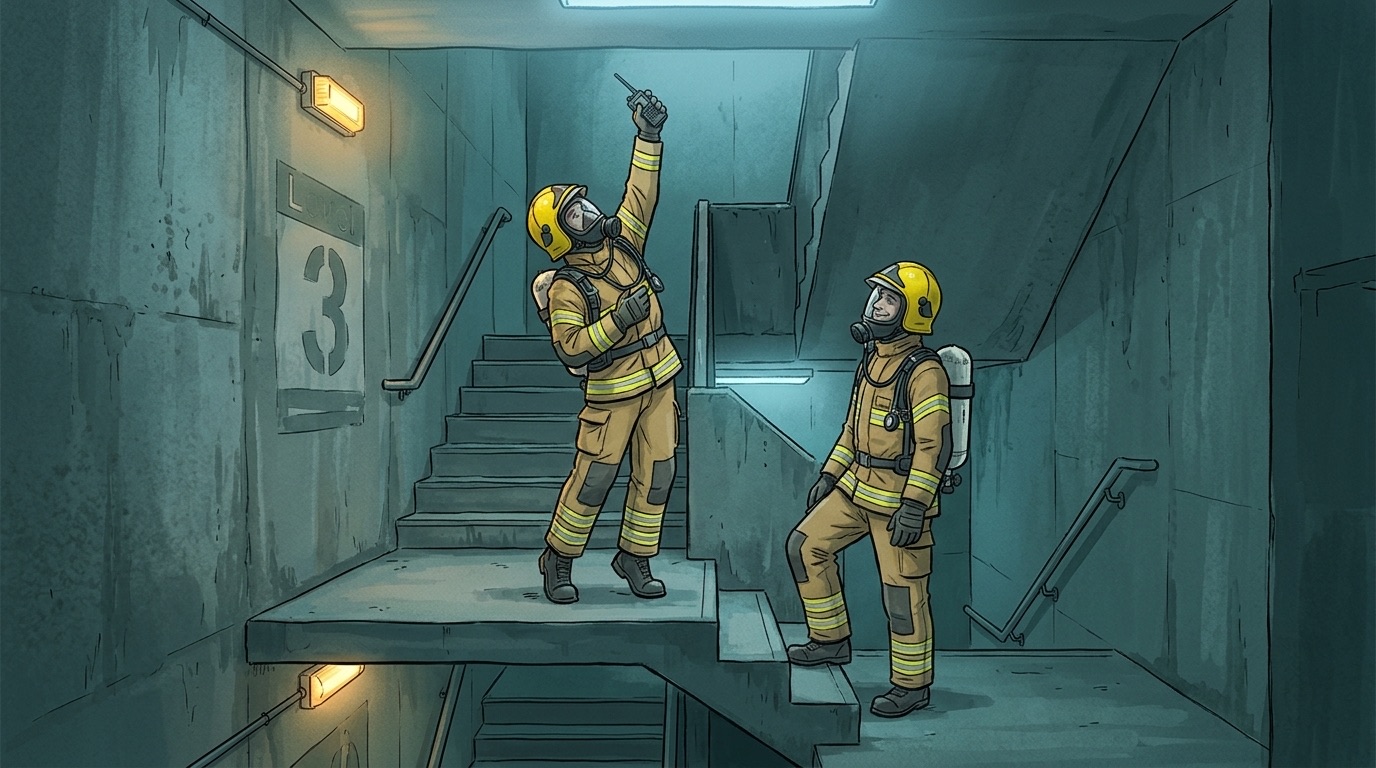
The stakes are simple. A crew that loses its radio may not hear the call to evacuate, and may have no way to report a BA emergency. The revised guidance now sets out what commanders and crews should do about that, before entry and once inside.
Three parts stand out for anyone who trains or assesses crews.
Losing comms is now a named hazard
The guidance on poorly managed incidents has a new section on loss of radio communications. It sets out where the link can break (within crews, between services and agencies, and between the incident ground and fire control) and why: faulty or damaged kit, outages, incorrect use, and buildings or terrain the signal cannot get through. It also lists what a loss puts at risk, from missing new hazard information to being unable to call for help.
Checks before entry, and a fallback inside
Before crews go into the hazard area, the incident commander should make sure they are on the right channels, have tested their radios and know about any blackspots. If comms fail inside, crews follow their service's fallback arrangements and report to the relevant commander as soon as they can, including what they did. The competence framework now expects commanders to brief crews so they know what to do if the radio goes. That is easy to assess in a scenario, and just as easy to leave out of one.
Planning coverage before the incident
Services are asked to consider testing radio coverage at known sites in advance and recording the results in Site-Specific Risk Information (SSRI). Contingency plans can be technical, such as repeaters, the systems already installed in some newer and underground buildings, or mobile phones. They can also be procedural: prioritising traffic, getting advice from a communications tactical adviser, moving somewhere with a better signal, or a tactical withdrawal when crews can no longer hear radio messages.
Smaller changes
The control measure "Effective communication" has been renamed "Effective communication at the incident ground" and largely rewritten. Handovers of command should be kept to a minimum where reasonably practicable. Multi-agency communication should follow JESIP principles, and crews should know the limits of both the digital and the analogue networks.
Why it changed
The revision was approved in July 2026 and published in September. It responds to a Grenfell Tower Inquiry Phase 2 recommendation that "firefighters be trained to respond appropriately to the loss of communications", which the government now lists as complete. Two related recommendations, on low-power intrinsically safe radios and on digital radios for all firefighters, are still in progress.
For incident command training, a loss-of-comms inject is a simple way to bring all of this into an exercise. Our quizzes are free to try if you want to check knowledge before or after.
The full guidance is on the NFCC website. CommandGridTools is independent and is not affiliated with or endorsed by the NFCC.